
Essay 08 · King Saul
Saul: When a Calling
Becomes a Possession
Chosen, anointed, and empowered by the Spirit, Saul began with promise. His tragedy unfolded as a calling received from God became a possession he struggled to preserve.
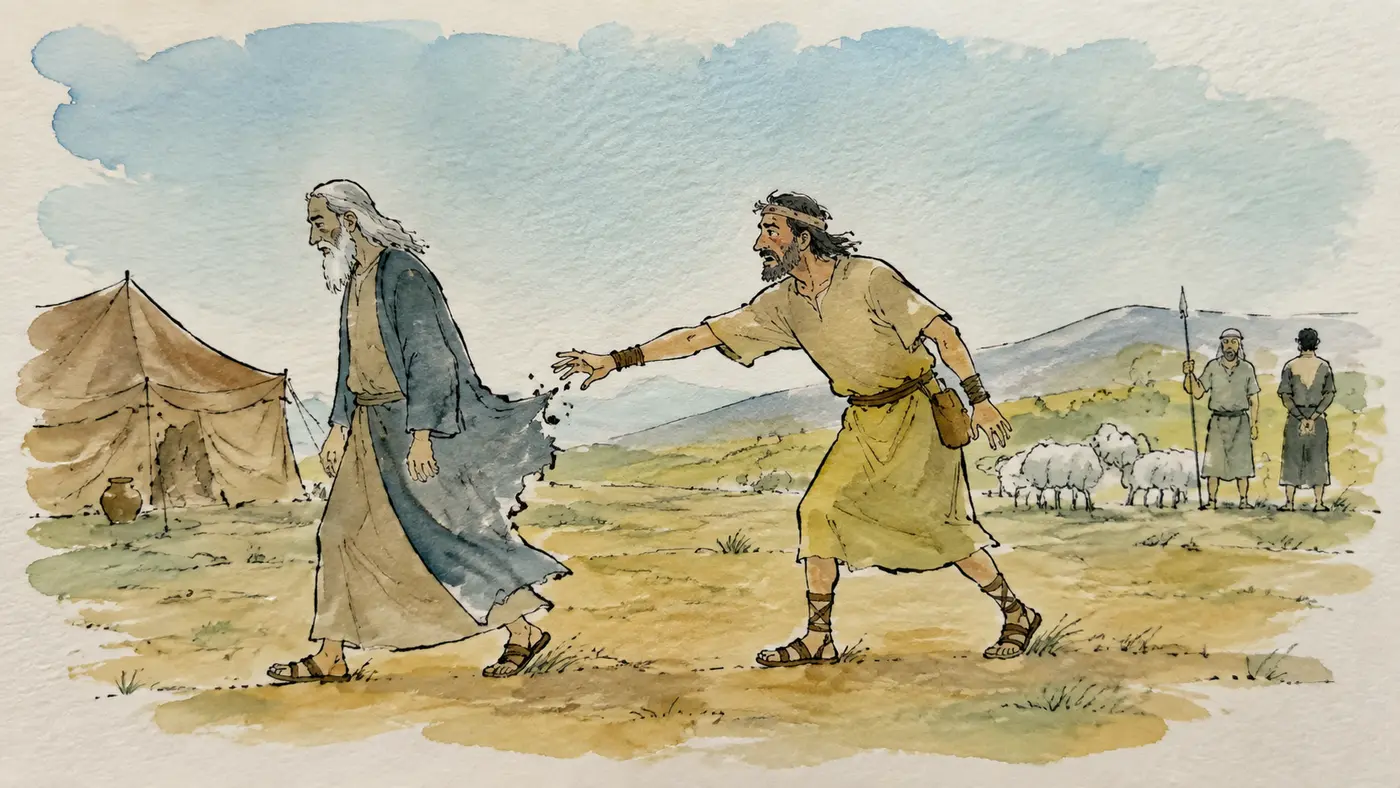
Saul’s story is one of the most unsettling in Scripture because it begins with so much promise. He was chosen by God, anointed by Samuel, empowered by the Spirit, and given victory over Israel’s enemies. He did not seize the throne through ambition. When first introduced, he was searching for his father’s lost donkeys, unaware that his journey would lead to the kingship of Israel.
Yet the man who began with reluctance eventually clung to the throne with desperate resolve. The king who once delivered Israel began consuming its strength to preserve himself. He repeatedly heard the word of God but learned to adjust it to circumstances, public expectations, and personal fear. In the end, the kingdom was taken from him.
Saul’s story belongs to Israel’s transition from the judges to the monarchy, but its warning reaches beyond kings and governments. The temptations that governed Saul are not peculiar to royal power. They appear wherever a calling becomes a possession, where obedience is negotiated, where reputation becomes more important than truth, and where the gifts of God are used to protect the self.
For New Testament believers, Saul presents a serious question: Is it possible to receive much from God, begin well, and yet gradually resist the rule of the King?
A King Like the Nations
Israel’s demand for a king arose from a real failure of leadership. Samuel had grown old, and his sons did not walk in his ways. They pursued dishonest gain, accepted bribes, and perverted justice. The elders therefore faced an understandable concern about the nation’s future.
Their proposed solution, however, exposed something deeper.
“Now appoint for us a king to judge us like all the nations,” they said (1 Samuel 8:5).
The problem was not simply that Israel wanted a king. Deuteronomy had already anticipated the possibility of monarchy and prescribed the character of Israel’s future ruler. The king was to be chosen by God, remain a brother among his people, resist the accumulation of military strength and wealth, and keep the law before him throughout his life. Israel’s king would exercise real authority, but he would remain beneath the authority of God.
The elders wanted more than orderly succession. They wanted visible security. They wanted a king who would go before them and fight their battles. The nation called to be distinct among the peoples now wanted to resemble them.
The LORD told Samuel, “They have not rejected you, but they have rejected me from being king over them” (1 Samuel 8:7).
The temptation remains familiar. The church confesses that Christ is King, yet believers can still search for security in the same places as everyone else. Influence, wealth, political strength, public approval, and impressive leadership can begin to carry a weight that belongs only to God. These things are not necessarily evil in themselves, just as monarchy was not inherently forbidden. The danger lies in the trust placed in them.
Israel wanted something visible enough to replace the discomfort of depending upon an unseen King. Christians may confess Christ’s sovereignty while living as though their security finally depends upon circumstances they can control.
Saul’s story begins not merely with the failure of a king, but with the misplaced desire of a people. Before Scripture asks what kind of ruler Saul will become, it asks what kind of kingdom Israel wants.
The Man Who Looked Like a King
Saul appeared well suited to Israel’s expectations. He was handsome and stood taller than anyone else among the people. When Samuel publicly presented him, he declared, “Do you see him whom the LORD has chosen? There is none like him among all the people” (1 Samuel 10:24).
The people answered, “Long live the king!”
There is no reason to dismiss Saul’s early calling as false. God chose him, Samuel anointed him, and the Spirit of God came upon him. He was given signs confirming his appointment, and God changed his heart. Saul was not merely pretending to possess divine favor. He received genuine gifts for a genuine vocation.
This is part of what makes his life so sobering. His later failure cannot be explained by saying that nothing authentic had ever happened to him. He had encountered the work of God. He had been equipped to serve. He had experienced the Spirit’s power and seen God grant victory through him.
The New Testament repeatedly warns believers not to confuse spiritual privilege with spiritual maturity. The Corinthian church possessed remarkable gifts, yet remained vulnerable to pride, division, sexual immorality, and idolatry. Paul therefore directed them back to Israel’s history and warned, “Let anyone who thinks that he stands take heed lest he fall” (1 Corinthians 10:12).
A gift is not the same as character. A calling is not the same as faithfulness. Past usefulness does not remove the need for present obedience.
Saul looked like a king, received the gifts of a king, and at first acted with the courage of a king. The unresolved question was whether he would remain a servant beneath the word of God.
That question still belongs to everyone who has received something from God.
The King Who Delivered Jabesh
Saul’s early reign contains genuine grace.
When Nahash the Ammonite besieged Jabesh-gilead and threatened to disgrace Israel, the Spirit of God rushed upon Saul. He gathered the tribes, led them against the Ammonites, and won a decisive victory.
Afterward, some among the people wanted to execute those who had initially questioned Saul’s kingship. Saul refused.
“Not a man shall be put to death this day,” he said, “for today the LORD has worked salvation in Israel” (1 Samuel 11:13).
At this point Saul recognized both the source and the purpose of his authority. The victory belonged to the LORD, and the day of salvation was not to become an opportunity for personal vengeance. Saul used his authority to deliver the threatened and protect the undeserving.
This is authority functioning within the kingdom of God. It receives strength from God, directs that strength toward the good of others, and returns the glory to him.
Jesus later described kingdom authority in similar terms. The rulers of the nations exercise authority for their own elevation, but greatness among his followers is expressed through service. “For even the Son of Man came not to be served but to serve,” he said, “and to give his life as a ransom for many” (Mark 10:45).
Saul’s first victory showed what his reign could have become. He was strongest when he understood himself as the instrument rather than the source of Israel’s deliverance. The kingdom was healthy when its king could say, in effect, that the LORD had saved Israel.
The same is true of Christian service. Ministry becomes dangerous when gratitude for being used by God quietly becomes a sense of ownership over what God has done. A believer may begin by serving because Christ is King and gradually come to regard the work, position, recognition, or influence as something that must be defended.
Saul’s beginning reminds us that authority is safest when it remains grateful, merciful, and conscious that salvation belongs to the Lord.
When Pressure Replaced Trust
The first decisive fracture appeared during war with the Philistines.
Israel’s military position was desperate. The Philistine forces were formidable, while Saul’s men hid in caves, tombs, cisterns, and pits. Others fled across the Jordan. Saul waited at Gilgal for Samuel, but as the people began scattering and Samuel did not arrive when Saul expected, the king offered the burnt offering.
Samuel appeared as soon as Saul had finished.
Saul explained that the people were leaving, the Philistines were assembling, and Samuel had not come. He therefore “forced” himself and offered the sacrifice (1 Samuel 13:12).
His explanation was not irrational. The danger was real. The army was dissolving. The enemy was approaching. Everything visible suggested that Saul needed to act.
Yet Samuel answered, “You have done foolishly. You have not kept the command of the LORD your God” (1 Samuel 13:13).
The central issue was whether Saul would trust God when obedience appeared costly. Under pressure, he treated the command of God as though it could be revised by circumstances. He did not reject God openly. He made what seemed to be a necessary adjustment.
This may be Saul’s most recognizable temptation.
Most believers do not begin by deciding to rebel against God. Compromise usually presents itself as necessity. The circumstances appear exceptional. The pressure seems unreasonable. Obedience feels impractical. What God has said remains respected in principle, but the present situation is treated as requiring another course.
The New Testament describes faithfulness differently. Believers are called to become doers of the word rather than hearers who deceive themselves (James 1:22). They are to present their bodies as living sacrifices and resist being conformed to the patterns of the age (Romans 12:1–2). Obedience is not proved when it is convenient. It is revealed when faithfulness requires trust.
Saul could see the departing soldiers. He could see the gathering Philistines. What he could not see was how obedience would preserve the kingdom.
Faith was required precisely because the outcome was not visible.
When the King’s Word Became Too Important
Saul continued to fight Israel’s enemies, but the conflict surrounding Jonathan exposed a change in the character of his rule.
Jonathan and his armor-bearer advanced against a Philistine garrison in courageous dependence upon God. Their action caused panic within the enemy camp, and Israel was drawn into the victory. Saul, however, placed the army under an oath forbidding anyone to eat until evening.
“Cursed be the man who eats food until it is evening and I am avenged on my enemies,” he declared (1 Samuel 14:24).
The language had shifted. The battle of the LORD had become Saul’s personal vengeance.
The oath weakened the army when the men needed strength. Jonathan, unaware of it, ate honey and was refreshed. He immediately recognized the damage caused by his father’s command: “My father has troubled the land” (1 Samuel 14:29).
When Jonathan was later identified as the one who had violated the oath, Saul declared that he must die. The people intervened and rescued the man through whom God had brought deliverance.
The episode reveals what happens when leaders become too invested in defending their own words. Saul’s command had been foolish, but withdrawing it would have required him to admit that he was wrong. He was prepared to sacrifice Jonathan rather than humble himself.
Christians are not immune to this form of pride. We may defend a judgment because it is ours, preserve a position because we have stated it publicly, or continue a harmful course because correction would require confession. Spiritual language can make this more dangerous, especially when personal decisions are presented as though they carried the authority of God.
The wisdom from above is “open to reason” (James 3:17). Christian maturity includes the humility to listen, reconsider, confess, and receive correction. Authority does not make repentance less necessary. It makes the refusal to repent more costly to others.
The kingdom belongs to Christ. No Christian leader’s reputation, decision, or personal authority is too important to be corrected beneath his word.
Partial Obedience Presented as Worship
Saul’s rejection reached its decisive point in the war against Amalek. Samuel commanded him to carry out God’s judgment, but Saul spared King Agag and preserved the best livestock.
When Samuel arrived, Saul greeted him with confidence: “I have performed the commandment of the LORD” (1 Samuel 15:13).
The sound of the animals contradicted him.
Saul first blamed the people. He then explained that the livestock had been preserved so that it could be sacrificed to the LORD. What God had forbidden was now presented as an act of worship.
“Has the LORD as great delight in burnt offerings and sacrifices,
—1 Samuel 15:22
as in obeying the voice of the LORD?
Behold, to obey is better than sacrifice,
and to listen than the fat of rams.”
Saul wanted the sacrifice to compensate for the disobedience. Yet worship cannot be offered as a substitute for surrender. Religious activity does not make rebellion acceptable.
The same temptation persists in Christian life. It is possible to sing, serve, give, preach, pray, and participate faithfully in the visible life of the church while protecting areas that have not been submitted to Christ. Religious activity may even become a means of avoiding the simpler and more difficult question: Are we doing what the Lord has said?
Jesus asked, “Why do you call me ‘Lord, Lord,’ and not do what I tell you?” (Luke 6:46). The question joins worship and obedience. To call Jesus Lord is to acknowledge his authority, not merely to speak reverently about him.
Samuel described Saul’s presumption as “iniquity and idolatry” (1 Samuel 15:23). Presumption becomes idolatrous because the self takes God’s place. Saul did not completely abandon the command; he edited it. He preserved the parts he judged useful and rejected what he considered expendable.
Partial obedience often retains enough of God’s command to appear faithful. That is why it is difficult to recognize. It allows us to say, as Saul did, “I have performed the commandment of the LORD,” while the evidence of what we have withheld remains within hearing.
The Fear of Man
When Saul could no longer defend his actions, he finally confessed: “I have sinned, for I have transgressed the commandment of the LORD and your words, because I feared the people and obeyed their voice” (1 Samuel 15:24).
This confession identifies one of the governing forces within his decline.
Saul was king, yet he was controlled by the people he ruled. He wanted their support, feared their departure, and depended upon their approval. Even after Samuel announced his rejection, Saul pleaded, “Honor me now before the elders of my people and before Israel” (1 Samuel 15:30).
His standing before the people remained urgent even when his standing before God had collapsed.
The fear of man is not merely timidity. It is the power other people’s opinions exercise over our obedience. It can lead us to say what will be accepted, conceal what may be criticized, or change direction when faithfulness threatens reputation.
Paul placed the alternatives sharply: “If I were still trying to please man, I would not be a servant of Christ” (Galatians 1:10). This does not authorize indifference to others or excuse harshness. It establishes the order of allegiance. A servant of Christ cannot allow public approval to become the final judge of obedience.
Saul’s fear of the people eventually made him dangerous to the people. Because he needed their approval, he could not lead them faithfully. The desire to preserve influence destroyed the integrity required to exercise it.
Believers are safest when they know whose verdict matters most. The kingdom belongs to Christ, and our lives are lived before him. Freedom from the fear of man does not come from thinking less of others, but from trusting more deeply in the approval received through Christ.
The Throne as a Possession
After David defeated Goliath, Saul initially welcomed him. But when the women celebrated David’s victories, Saul became angry.
“What more can he have but the kingdom?” he asked (1 Samuel 18:8).
From that point, Saul increasingly regarded David through the lens of threat. David’s success no longer strengthened Israel; it diminished Saul. The king could not rejoice that God was delivering the kingdom because the deliverer might receive more honor than he did.
Jealousy changed the meaning of everything Saul saw. David’s victories became evidence of ambition. Jonathan’s friendship became betrayal. The priests’ assistance became conspiracy. Faithful service became a threat because Saul’s principal concern was no longer the good of Israel but the preservation of Saul.
This is what happens when a calling becomes a possession.
Everything entrusted by God can be held in one of two ways. It can be received as a stewardship to be used for others, or possessed as a personal territory to be defended. Ministry, influence, reputation, vocation, family responsibility, and spiritual gifts can all become entangled with identity. Another person’s success then feels like our loss.
The New Testament calls believers to a different posture: “In humility count others more significant than yourselves” (Philippians 2:3). This is possible because Christ did not preserve his status at the expense of others. He emptied himself, took the form of a servant, and humbled himself to the point of death.
Saul used the kingdom to preserve himself. Jesus gave himself for the kingdom’s people.
That contrast reaches the heart of Christian discipleship. Life beneath Christ’s reign is not built upon protecting our place. It is formed by the security that enables us to serve, release, encourage, and rejoice when God works through someone else.
The Kingdom Consumed by Self-Preservation
Saul’s fear eventually produced violence.
When the priests at Nob unknowingly assisted David, Saul accused them of conspiracy. Ahimelech protested that David was known as the king’s faithful servant and son-in-law. Saul nevertheless ordered the priests to be killed.
The Israelite guards refused. Doeg the Edomite obeyed.
Eighty-five priests died, and the priestly city of Nob was destroyed. Saul had spared Agag when God commanded judgment against Amalek. He now showed no mercy toward the priests of Israel.
The reversal is severe. The king appointed to deliver the people had begun destroying them. The army that should have defended Israel from the Philistines was used to hunt David. Priests were killed, Jonathan’s future was opposed, and the nation’s strength was consumed because Saul could not release the throne.
Sin rarely remains confined to the person protecting it. Saul’s inward refusal eventually wounded families, communities, and the kingdom itself. What began as fear became disobedience; disobedience required justification; justification hardened into jealousy; jealousy produced violence.
The New Testament therefore treats the sins of the heart with seriousness. Anger, envy, selfish ambition, and bitterness are not private inconveniences. When allowed to grow, they disorder the communities in which believers live. James writes that where jealousy and selfish ambition exist, “there will be disorder and every vile practice” (James 3:16).
The kingdom of Christ moves in the opposite direction. Its King does not destroy others to preserve himself. He lays down his life for the sheep.
The Voice He Would Not Hear
Near the end of Saul’s reign, the Philistines gathered for war. Samuel was dead, and Saul was afraid. He inquired of the LORD, but received no answer by dreams, Urim, or prophets.
Saul then sought a medium at Endor. Disguised and moving by night, he asked to hear from the dead prophet whose living word he had repeatedly resisted.
The scene is filled with irony. Saul wanted guidance, but he had not wanted obedience. He sought a new word because he had refused the word already given.
The message he received did not change. The kingdom had been taken from him. Israel would fall before the Philistines. Saul and his sons would die.
There is a difference between seeking God’s guidance and seeking divine permission for the course we already prefer. Believers may repeatedly ask what God wants while resisting what Scripture has already made clear. We can search for another interpretation, another counsel, or another circumstance that will remove the demand of obedience.
God’s guidance is not ordinarily given to help us avoid submission. The Christian life is not a search for secret knowledge detached from the revealed word. It is a life of listening to the Son.
Jesus said, “My sheep hear my voice, and I know them, and they follow me” (John 10:27). Hearing and following belong together. Saul wanted to hear because he was afraid of the future, but throughout his reign he had resisted following when the word challenged his desires.
The tragedy of Endor did not begin with divine silence. It began with years of refused instruction.
A King Fallen on Gilboa
Saul’s final battle took place on Mount Gilboa. His sons, including Jonathan, were killed. Saul was badly wounded and fell upon his own sword. The Philistines displayed his body on the wall of Beth-shan.
Yet the account closes with an act of loyalty. The men of Jabesh-gilead—the city Saul had rescued at the beginning of his reign—travelled through the night to recover the bodies of Saul and his sons. They mourned and buried them.
Their courage preserves the memory of Saul’s early deliverance. The man who died on Gilboa was not without gifts, victories, or moments of honor. He had once rallied Israel, rescued the threatened, spared his opponents, and declared that the LORD had worked salvation.
This makes his story tragic rather than simple.
Scripture does not require us to deny the good accomplished through a deeply flawed person. Nor does past usefulness require us to excuse later unfaithfulness. Saul’s entire story must be allowed to stand. God truly used him, and Saul truly departed from the path entrusted to him.
The warning for believers is not that failure is inevitable or that one act of disobedience places a person beyond grace. The New Testament is filled with restoration, forgiveness, and renewed obedience. Peter denied Jesus and was restored. The difference is not that faithful believers never fall, but that they return when confronted.
Saul often confessed when consequences became unavoidable, but his confessions seldom became a settled surrender of the throne. He regretted what his sin threatened to take from him without relinquishing the self-rule from which the sin had grown.
True repentance does more than grieve the loss. It returns to the King.
Living Beneath the True King
The Chronicler concludes that Saul died for his breach of faith because he did not keep the command of the LORD and sought guidance from a medium rather than seeking the LORD. God therefore turned the kingdom over to David (1 Chronicles 10:13–14).
Saul’s life reveals what happens when a person receives authority from God but ceases to live beneath it. His failure did not arise from a lack of ability, opportunity, or spiritual experience. It arose from a heart that increasingly reserved the right to decide when and how it would obey.
This is why his story remains relevant to New Testament believers.
Every Christian lives within the kingdom Saul struggled to understand. We have been delivered from the domain of darkness and transferred into the kingdom of God’s beloved Son (Colossians 1:13). We confess that Jesus is Lord. Our lives, bodies, relationships, vocations, gifts, and futures belong to him.
Yet the temptation toward self-rule remains.
We may obey until obedience threatens our security. We may worship while protecting what has not been surrendered. We may serve until another person receives the recognition. We may seek guidance while resisting what God has already said. We may receive a calling as a gift and gradually defend it as a possession.
Saul’s history warns us that outward usefulness cannot sustain a life that is inwardly resisting the King. Spiritual gifts do not remove the need for character. Religious sacrifice cannot replace obedience. Public honor cannot compensate for the loss of integrity. No position received from God can safely be treated as though it belongs to us.
But Saul’s story also directs attention beyond itself.
Israel needed a king who would remain perfectly beneath the word of God. It needed one who would not preserve himself at the expense of his people, use authority to defend his own position, or revise obedience when suffering approached.
Jesus is that King.
Where Saul grasped the throne, Jesus refused the kingdoms offered by the tempter. Where Saul feared the people, Jesus remained obedient to the Father despite rejection. Where Saul destroyed others to preserve himself, Jesus gave himself to save his enemies. Where Saul’s disobedience tore the kingdom from his house, Christ’s obedience unto death led to his exaltation as Lord of all.
The pastoral answer to Saul is therefore not greater confidence in ourselves. It is deeper submission to Christ.
The kingdom does not depend upon our ability to secure our place within it. Its throne is already occupied. Its future does not rest upon our strength. We are free to obey because Christ reigns, free to repent because his mercy is sufficient, and free to serve without possessing because nothing entrusted to him can finally be lost.
Saul spent the latter part of his life trying to preserve a kingdom that had never belonged to him.
The believer is called to something better: to receive the kingdom with gratitude, serve within it faithfully, and entrust both the work and its outcome to the King.
Scripture quotations are from the ESV® Bible (The Holy Bible, English Standard Version®).